Now, I don't claim to be an expert on the U.S. Congress, but I do
play one on the internet. As a results of my job I keep pretty well informed about the process and procedure of how the legislative branch goes about doing its business. I am, after all, the world's foremost expert on computerized simulations of Congress (
shocking, I know).
But even with all that knowledge, I cannot make heads or tails of the first legislative action taken by the Senate. You may have read about it, as it's in
all the papers. My commentary is not on the substance of the bill, which seems all well and good, but rather the vehicle through which the action is being taken.
Article I of the Constitution says "Each House may determine the rules of its proceedings," which is the basis for the
Rules of the United States Senate and the
Rules of the United States House of Representatives. Both sets of rules are
very different from eachother, reflecting the unique nature of the chambers. For example, the Senate is home to the
filibuster, a somewhat controversial rule that has been used by
conservatives and
liberals to fight for causes against a majority of senators. The House, with its expansive membership, has the Rules Committee and their
special rules which allow for bill by bill modification of the procedure for consideration. This allows the majority to cut off debate, limit amendments, and generally get their way every time.
What's critical here is that both sets of rules are the sole province of the respective chambers. The House sets its rules and there isn't a thing the Senate can do to stop them. So what does this have to do with the new Senate ethics package?
When the House brought up its ethics package the decision was made to use the House Rules as the vehicle instead of actual law. The upside of such a decision is that you don't have to get Senate approval or the President's signature. But the downside (depending on your perspective) is that the rule only exists for the duration of the current Congress. Come the 111th Congress the House can decide to simply not re-up the ethics rules. It's a tradeoff between expediency and permanency.
To make a change to the House Rules the House adopts a House Resolution, known simply as an H.Res. For the 110th Congress the House Rules took the form of
H.Res 6. This is a different form of legislation then if the House were to enact a law. In those cases it uses a bill, and refer to them with just an H.R. H.R. 1 was the
Implementing the 9/11 Commission Recommendations Act. Again, the critical difference is that H.Res 6 took effect once approved by the House, where H.R. 1 will require Senate action and is subject to Presidential veto.
The Senate is a little different. First, because the Senate has staggerred six year terms, in each new Congress only 1/3rd of the membership is up for reelection. This means the Senate does not dissolve in the way the House does. The practical result is that the Senate need not approve new rules every two years, it can simply keep the rules from the last Congress and no one would be the wiser.
Which brings me to into the home stretch of this post... the Senate action to amend the Senate Rules took the form of
S.1, not S.Res 1. As you may have guessed, an S. is used to adopt laws, just like an H.R., and require bicameral action and are subject to Presidential veto.
But wait, your saying, couldn't it be that the Senate uses the S. designation to amend their rules for reasons of precedent?! Sure, that's possible. But then you have to explain §213, which amends
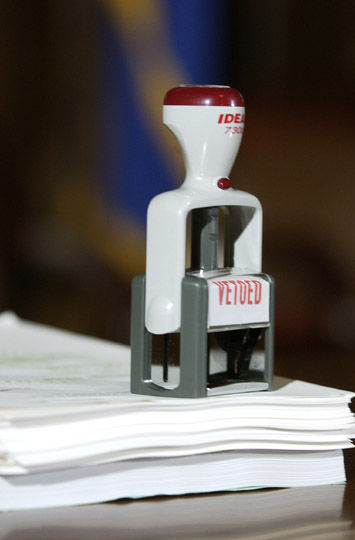
2 U.S.C. 1605. That's law folks, not just Senate Rules, which means the House gets a say and the President can use his
fancy stamp*.
So what am I (or you, for that matter) supposed to make of all this? If the House does not adopt similar language through an H.R., what becomes of those sections of S.1 that were just related to the Senate Rules? Is it permissible to mix rules changes with law changes? Is there a dependency here, or do the rules go into effect regardless of the outcome to the law amendments? A literal reading of the Constitution says that the Senate may adopt rules, and in this instance they
voted 96 - 2 to adopt them.
Strikes me as all very odd.
* Actual presidential veto stamp not featured here. Why are there not photos of the stamp available online? Are we afraid the terrorists will somehow use it against us?