I started this blog a while ago now... back when I was still in law school. I've stuck with Blogger as a platform for longer than any other, so I feel like I have something invested here. Since it's inception, Pro Bono Geek has been a decidedly political blog, emphasizing the Pro Bono over the Geek. My law school and student government experience provided a lot of good fodder for blogging... and while the online comments I received were never great in number, I was always surprised at how many people at least read what I posted and told me in the "real" world.
But since I've moved to Santa Cruz, I've been posting a lot less. I think being out-of-sync from actual political discourse has been a big part. My political world is pretty much Sarah and the Washington Post. On top of that, I'm not entirely certain I have anything new to contribute to the larger discussion. For the most part I'm just recycling what you can read elsewhere tempered by a bit of market-idealism. Yes, I've got the occasional intellectual property rant, but I think those were more for me than anyone else.
The question remains: if the blog is to continue, what will it be about? I think, perhaps, the answer to this question lies where I started this post: Pro Bono Geek. Except, this time, maybe we need a bit more geek. I feel like I'm got an interesting viewpoint on the larger technical universe right now. Author of the world's formost legislative simulation website, a sprawling Perl CGI application in desperate need of love (mod_perl anyone?); system administrator for one of the largest Zope deployments around hosting some of the biggest names in Democratic politics; a lieutenant of David Chelimsky world renowned Agile evangelist and core contributor to R-Spec with whom I will developing some kick-ass stuff in the next couple of years; power-user of Debian GNU/Linux and KDE; and javascript wizard for a leader in political web design. For better or worse, my life has taken a decided turn towards the geeky end of my personality, and it's time I embrace that way of life.
To that end, I'm going to start posting again (trying for once a week) about the interesting technical/geeky stuff I'm doing... tragically, not everything I do can be disclosed, but it's not like a Google-NDA, so I'm freer than most to discuss my latest thoughts on all manner of topics. For some of you, this may be that final excuse to kick me off your RSS reader... and I understand that. For others, you might finally be interested in what I write here. Others may be interested in just continued life updates, and I'm hoping to get back into the swing of that too, but no promises.
Oh, and if you were hoping I would stop posting political content all together, I have some bad news for you.
Sunday, March 16, 2008


Thursday, February 14, 2008
In Defence of our Nomination Process
Seems this presidential election cycle has uncovered a new American past-time: complaining about the nomination process. You can't swing a dead cat without hitting a blogger, newspaper editorialist, or relative who has a beef with the rules that govern this process. Mind you, their complaints are not directed at the candidates themselves, the ire is reserved for the cold and impersonal regulations that govern the candidates' behavior.
I'm going to pretty much ignore the Republican process here, because this is about "our" process, not "their" process. Let their own youthful rules wonks defend that momentum obsessed coronation processes. This is a rebuttal to the critiques of the Democratic party. There are four major complaints I've heard leveled this cycle, so allow me to take them one at a time:
Caucuses are Out-Dated
I read this one just today at my alma-mater's newspaper. Yes, I still read The Daily... old habits die hard. Of course, this argument is also being implicitly made by the Clinton campaign because the scheduling of the caucuses, one hour on a weekend, tend to be unfavorable to working class voters that Clinton believed she had wrapped up (c.f. Potomac Primary exit polls). Folks also like to throw in absentee voters, especially military folks, who are simply unable to participate. These aren't bad points, but they make a fundamental assumption about the nomination process that is not, and never has been, true.
It seems caucus nay-sayers are under the mistaken impression they have an unalienable right to participate in the nomination process. Well, I suggest everyone break out your pocket constitution and see if you can find any reference to such a right... while you're there, check to see if there is any mention of nominations at all. None? That's because nominations are a construction of political parties, a way for party members to decide who to place the party's resources behind. Turns out, for practical reasons, you cannot get elected to the office of President in a nation of America's size without the resources of either the Democratic or Republican party, but it's not a Constitutional requirement, and no one has an inalienable right to participate in that decision.
Starting from that understanding, the decision to caucus instead of hold a primary is really a matter of regional and historical preference. Primaries are impersonal but efficient, caucuses are more home-town but unwieldy. But the decision to use either one is made by members of the party, not the states and not the general electorate. The Washington State Democratic Party is responsible for deciding how it is going to allocate its delegates based on shared objectives and values. This ensures that the party faithful have their say in the process, because being a member of the faithful comes with a cost...
Consider, in 2004 I caucused for Howard Dean... but John Kerry ended up with the nomination. And like a good party faithful, I voted for Mr. Kerry. I didn't vote Nader, Bush, or just stay home. I accepted my party's nominee because the party faithful had decided to back Kerry... but more importantly, because in the general election I really had no other choice. The caucus was my one chance to cast a meaningful ballot.
Super Delegates are Non-Democratic
This is a long identified "flaw" in the Democratic nomination process.. nearly 25% of the delegates are individuals who are not pledged going into the convention. But it's simply incorrect to consider them "unelected" or "unaccountable." Super Delegates are elected representatives, DNC committee members, and interest group representatives (like union leaders). These are the folks who make decisions for us ALL the time, because they were elected to do so. Being a part of the nomination process is a natural role for them to hold.
What really gets me about this argument is the claim that Super Delegates could "make the difference"... the difference?! Depending on the margin between the two candidates, Wyoming could make the difference. Any block of votes can tip any election, there is nothing special about the Super Delegates. That doesn't stop pundits from assigning near super levels of coordination to these elected representatives. There is an assumption that if Clinton and Obama show up in Denver with only a few hundred delegates gap between them, then the Super Delegates will simply "chose" the winner. I'd just like to see that actually happen! Can you imagine all the Democratic members of Congress, State governors, DNC committee members, and interest groups going into a room and deciding "let's all vote for so and so." These folks can't agree on a response to the war, were they stand on fiscal discipline, or just how much spying the government should be allowed to do on it's own people... why do we think they'll be able to agree on a single candidate for president? The only shared criteria I've been able to decipher is that the candidate not be named George W. Bush, but beyond that, I think these Super Delegates are going to behave like the independent rational actors we elected them to be. If the state's cannot figure it out between now and Denver, I can think of no better group of people to act as a tie breaker than our elected leaders.
Proportional Representation is Unfair
I don't even get this... but a Washington Post editorialist who shall remain nameless (*cough* Ruth Marcus *cough*) seems to be making the argument. The core point seems to be, Clinton won California, so why doesn't she have a HUGE lead? That's how it works in the General, darn it! Yeah, well, your complaints ought to be directed at the General Election, not the primaries. Winner-take-all only makes sense if your objective is to have a coronation like the Republicans have. But, if your intention is to reflect the subtleties of the Democratic party, then you've got to do the proportional thing. Having said that, there is some strange math with congressional districts that have an odd number of delegates. I can't really defend that, except to say that electoral math is a long held tradition in this country, and you've got to be willing to play the game.
It's All Too Confusing
Good! It's supposed to be confusing. Systems that are fair often are, because an "easy" system is also one that can be manipulated and controlled in scary ways (see the discussion about winner-takes-all). But, let's address a common critique that confusing means non-transparent. Transparency has become a big buzzword this decade, and for good reason. I'm all for transparency. But that something is confusing does not mean it's not transparent. Perhaps it takes some knowledge and a little research to understand, but as long as the information is there for anyone to examine, then it's transparent.
Great example... our judicial system. Amazingly transparent. All of the briefs, court records, and decisions are right there for anyone to look at. It's way more transparent then the legislative branch (let's not even get started about the executive branch). Trouble is, all those documents are complicated and require training to understand... which is to say, it's complicated. But the fact that I can follow a judicial decision from the very start of the incident all the way to the final determination is the kind of transparency we can only dream of in the other branches.
So, to those who complain they don't understand the nomination process... check out Wikipedia or ask someone involved with your local state political party. No one is trying to hide the ball here, we're just making sure the rules ensure a fair resolution to the single most important question facing Democrats today: who will represent our party in the race for the President of the United States.
I'm going to pretty much ignore the Republican process here, because this is about "our" process, not "their" process. Let their own youthful rules wonks defend that momentum obsessed coronation processes. This is a rebuttal to the critiques of the Democratic party. There are four major complaints I've heard leveled this cycle, so allow me to take them one at a time:
Caucuses are Out-Dated
I read this one just today at my alma-mater's newspaper. Yes, I still read The Daily... old habits die hard. Of course, this argument is also being implicitly made by the Clinton campaign because the scheduling of the caucuses, one hour on a weekend, tend to be unfavorable to working class voters that Clinton believed she had wrapped up (c.f. Potomac Primary exit polls). Folks also like to throw in absentee voters, especially military folks, who are simply unable to participate. These aren't bad points, but they make a fundamental assumption about the nomination process that is not, and never has been, true.
It seems caucus nay-sayers are under the mistaken impression they have an unalienable right to participate in the nomination process. Well, I suggest everyone break out your pocket constitution and see if you can find any reference to such a right... while you're there, check to see if there is any mention of nominations at all. None? That's because nominations are a construction of political parties, a way for party members to decide who to place the party's resources behind. Turns out, for practical reasons, you cannot get elected to the office of President in a nation of America's size without the resources of either the Democratic or Republican party, but it's not a Constitutional requirement, and no one has an inalienable right to participate in that decision.
Starting from that understanding, the decision to caucus instead of hold a primary is really a matter of regional and historical preference. Primaries are impersonal but efficient, caucuses are more home-town but unwieldy. But the decision to use either one is made by members of the party, not the states and not the general electorate. The Washington State Democratic Party is responsible for deciding how it is going to allocate its delegates based on shared objectives and values. This ensures that the party faithful have their say in the process, because being a member of the faithful comes with a cost...
Consider, in 2004 I caucused for Howard Dean... but John Kerry ended up with the nomination. And like a good party faithful, I voted for Mr. Kerry. I didn't vote Nader, Bush, or just stay home. I accepted my party's nominee because the party faithful had decided to back Kerry... but more importantly, because in the general election I really had no other choice. The caucus was my one chance to cast a meaningful ballot.
Super Delegates are Non-Democratic
This is a long identified "flaw" in the Democratic nomination process.. nearly 25% of the delegates are individuals who are not pledged going into the convention. But it's simply incorrect to consider them "unelected" or "unaccountable." Super Delegates are elected representatives, DNC committee members, and interest group representatives (like union leaders). These are the folks who make decisions for us ALL the time, because they were elected to do so. Being a part of the nomination process is a natural role for them to hold.
What really gets me about this argument is the claim that Super Delegates could "make the difference"... the difference?! Depending on the margin between the two candidates, Wyoming could make the difference. Any block of votes can tip any election, there is nothing special about the Super Delegates. That doesn't stop pundits from assigning near super levels of coordination to these elected representatives. There is an assumption that if Clinton and Obama show up in Denver with only a few hundred delegates gap between them, then the Super Delegates will simply "chose" the winner. I'd just like to see that actually happen! Can you imagine all the Democratic members of Congress, State governors, DNC committee members, and interest groups going into a room and deciding "let's all vote for so and so." These folks can't agree on a response to the war, were they stand on fiscal discipline, or just how much spying the government should be allowed to do on it's own people... why do we think they'll be able to agree on a single candidate for president? The only shared criteria I've been able to decipher is that the candidate not be named George W. Bush, but beyond that, I think these Super Delegates are going to behave like the independent rational actors we elected them to be. If the state's cannot figure it out between now and Denver, I can think of no better group of people to act as a tie breaker than our elected leaders.
Proportional Representation is Unfair
I don't even get this... but a Washington Post editorialist who shall remain nameless (*cough* Ruth Marcus *cough*) seems to be making the argument. The core point seems to be, Clinton won California, so why doesn't she have a HUGE lead? That's how it works in the General, darn it! Yeah, well, your complaints ought to be directed at the General Election, not the primaries. Winner-take-all only makes sense if your objective is to have a coronation like the Republicans have. But, if your intention is to reflect the subtleties of the Democratic party, then you've got to do the proportional thing. Having said that, there is some strange math with congressional districts that have an odd number of delegates. I can't really defend that, except to say that electoral math is a long held tradition in this country, and you've got to be willing to play the game.
It's All Too Confusing
Good! It's supposed to be confusing. Systems that are fair often are, because an "easy" system is also one that can be manipulated and controlled in scary ways (see the discussion about winner-takes-all). But, let's address a common critique that confusing means non-transparent. Transparency has become a big buzzword this decade, and for good reason. I'm all for transparency. But that something is confusing does not mean it's not transparent. Perhaps it takes some knowledge and a little research to understand, but as long as the information is there for anyone to examine, then it's transparent.
Great example... our judicial system. Amazingly transparent. All of the briefs, court records, and decisions are right there for anyone to look at. It's way more transparent then the legislative branch (let's not even get started about the executive branch). Trouble is, all those documents are complicated and require training to understand... which is to say, it's complicated. But the fact that I can follow a judicial decision from the very start of the incident all the way to the final determination is the kind of transparency we can only dream of in the other branches.
So, to those who complain they don't understand the nomination process... check out Wikipedia or ask someone involved with your local state political party. No one is trying to hide the ball here, we're just making sure the rules ensure a fair resolution to the single most important question facing Democrats today: who will represent our party in the race for the President of the United States.
Friday, December 21, 2007
Someone Has to Win? Really?
One of my favorite political blogs is The Fix, a regular feature of www.washingtonpost.com, written by Chris Cillizza. On Fridays The Fix has a special feature called The Line where he gives a rundown of the horserace as he sees it. Today's The Line is entitled, "Someone Has to Win the GOP Nomination." So far, I'm willing to accept that someone must eventually win the GOP Nomination. Where I disagree with the esteemed political writer is:
Yes, it is true that a majority of delegates will be decided within the next two months, but if things go as they have been, there is no certainty that any one candidate will have amassed the number of delegates necessary to win the nomination. Granted, it's been many a year since this has happened, but there used to be a time when the nominee was chosen at the convention by elected delegates doing more than just waving signs and clapping their hands. If a clear winner does not emerge from the pack to claim a majority, then the convention will once again reign supreme. All the political commentary about the split nomination race seems to miss the actual process of the nomination and how it functions in reality. The nomination is not chosen by an election where a plurality is enough. Strict rules govern the processes, and fifty years of not needing to use them doesn't make them any less relevant.
This has an interesting impact on the decisions of the national party to strips delegates from states violating the nominating calendar, namely Florida and Michigan. Conventional wisdom says this is all positioning because the eventual nominee, who will control the Rules Committee, will seat the delegates anyway. But what if the Rules Committee seats are split among the candidates and thus lack the majority votes to change the rules? What then?
So no, no one has to win anything in the next two months. But if someone doesn't, well, then we are in for some interesting times come convention time.
What gets lost in all of the negativity about the Republican field is that in less than two months, someone will be the party nominee. Put simply: Someone has to win this thing.Less than two months?! That's just a bald-face lie.
Yes, it is true that a majority of delegates will be decided within the next two months, but if things go as they have been, there is no certainty that any one candidate will have amassed the number of delegates necessary to win the nomination. Granted, it's been many a year since this has happened, but there used to be a time when the nominee was chosen at the convention by elected delegates doing more than just waving signs and clapping their hands. If a clear winner does not emerge from the pack to claim a majority, then the convention will once again reign supreme. All the political commentary about the split nomination race seems to miss the actual process of the nomination and how it functions in reality. The nomination is not chosen by an election where a plurality is enough. Strict rules govern the processes, and fifty years of not needing to use them doesn't make them any less relevant.
This has an interesting impact on the decisions of the national party to strips delegates from states violating the nominating calendar, namely Florida and Michigan. Conventional wisdom says this is all positioning because the eventual nominee, who will control the Rules Committee, will seat the delegates anyway. But what if the Rules Committee seats are split among the candidates and thus lack the majority votes to change the rules? What then?
So no, no one has to win anything in the next two months. But if someone doesn't, well, then we are in for some interesting times come convention time.
Wednesday, December 05, 2007
The Court & The Public
In the past week I have read no fewer than three different editorials about the need for the Supreme Court to allow cameras into oral arguments, or at a minimum release same day tapes of the proceedings. Most recently I read this anemic editorial by the Washington Post. The outcry is the same... people deserve the right to see the proceedings of the court because it's a public institution. I couldn't agree more with the objective, transparency of public institutions is paramount to good decision making... even courts, who are the least participatory of our political institutions.
Where these critics go wrong is in thinking that cameras make a difference... or that oral arguments are someone the "functioning" of the court. The events leading up to a legal decision are a complex web of filings and briefs, of which oral arguments is but one tiny piece. Lawyers generally agree that cases are won and lost on the brief... oral argument is just an chance to run through the briefs and address questions raised by the justices. But it's not like the questions are unexpected and no Supreme Court practitioner worth their salt leaves an unanswered question in hopes the topic comes up during orals. It's all there, in the brief, which are publicly available.
Yet, this isn't even the most amazing part about how incredibly transparent our legal process really is. Consider for a moment the House of Representatives. On a given day the 425 members cast votes on a number of different issues. Now imagine if each of those members had to write down why they voted the way the did, had to cite previous votes by themselves and those who held the seat before them as justification, and had to provide a detailed step-by-step analysis of their thinking. Wouldn't that be something? If the members of Congress had to publicly justify every single one of their votes! How would constituents feel if their member wrote they voted for a particular provision because they got a fat donation check!
Of course, House members don't have to justify their votes... nor do Senators... nor do Presidents (except in the case of a Veto, which is a whole other can of worms). Two out of three branches of government may exercise their constitution powers without a single word of explanation and routinely do so. The Court, in shocking contrast, explains everything. Complete with citations, justifications, historical narratives, transcripts, finds of fact, depositions, and the decisions of the District and Appellate Court from which the appeal originated. It's an overwhelming amount of information and quite frankly more transparency than your average Joe is really interested in. But, it's the law, and the law isn't easy... the law is complex, and no matter how simplistic campaigns may make governing seem, we should never allow the law to become a sound-byte.
So why then fixate on oral arguments? It is but one small (some might argue insignificant) part of the process. When a whole world of records is available to analyze, why are we getting all worked up over this? Lawyers, who have the most to gain from a transparent court, have never demanded it... so why suddenly is everyone else?
I don't have an answer, but I fear it's part of a larger trend to treat the court (federal or state, doesn't seem to matter) as just another political body, whose officials should be subject to the whim of the electorate and the twenty-four hour media machine. It's a bad trend that strikes a blow at yet another of our critical institutions designed to protect the minority from the tyranny of the majority. What I do know is that someday I want to attend an oral argument, not for the knowledge, but for the singular experience. If I ever want to know what actually happened in a case, I'll crack open a book.
Where these critics go wrong is in thinking that cameras make a difference... or that oral arguments are someone the "functioning" of the court. The events leading up to a legal decision are a complex web of filings and briefs, of which oral arguments is but one tiny piece. Lawyers generally agree that cases are won and lost on the brief... oral argument is just an chance to run through the briefs and address questions raised by the justices. But it's not like the questions are unexpected and no Supreme Court practitioner worth their salt leaves an unanswered question in hopes the topic comes up during orals. It's all there, in the brief, which are publicly available.
Yet, this isn't even the most amazing part about how incredibly transparent our legal process really is. Consider for a moment the House of Representatives. On a given day the 425 members cast votes on a number of different issues. Now imagine if each of those members had to write down why they voted the way the did, had to cite previous votes by themselves and those who held the seat before them as justification, and had to provide a detailed step-by-step analysis of their thinking. Wouldn't that be something? If the members of Congress had to publicly justify every single one of their votes! How would constituents feel if their member wrote they voted for a particular provision because they got a fat donation check!
Of course, House members don't have to justify their votes... nor do Senators... nor do Presidents (except in the case of a Veto, which is a whole other can of worms). Two out of three branches of government may exercise their constitution powers without a single word of explanation and routinely do so. The Court, in shocking contrast, explains everything. Complete with citations, justifications, historical narratives, transcripts, finds of fact, depositions, and the decisions of the District and Appellate Court from which the appeal originated. It's an overwhelming amount of information and quite frankly more transparency than your average Joe is really interested in. But, it's the law, and the law isn't easy... the law is complex, and no matter how simplistic campaigns may make governing seem, we should never allow the law to become a sound-byte.
So why then fixate on oral arguments? It is but one small (some might argue insignificant) part of the process. When a whole world of records is available to analyze, why are we getting all worked up over this? Lawyers, who have the most to gain from a transparent court, have never demanded it... so why suddenly is everyone else?
I don't have an answer, but I fear it's part of a larger trend to treat the court (federal or state, doesn't seem to matter) as just another political body, whose officials should be subject to the whim of the electorate and the twenty-four hour media machine. It's a bad trend that strikes a blow at yet another of our critical institutions designed to protect the minority from the tyranny of the majority. What I do know is that someday I want to attend an oral argument, not for the knowledge, but for the singular experience. If I ever want to know what actually happened in a case, I'll crack open a book.
Tuesday, November 27, 2007
State Quarter Quiz
I've been a collector of state quarters since the first year they came out. In fact, just this year I collected the Washington State quarter, an event I've been anticipating for eight years!
I got a quiz in the mail a few days ago testing ones knowledge of the backs of the state quarters with the text removed. Go ahead, give it a try. I got 17 out of 20 right, but some of them are mighty tricky.
Seeing the quarter backs without the words made me appreciate the state histories and landscapes that we so often forget about. Divorced from my contemporary perception, I begin to remember that each of the states has their own complicated story of what it means to be from Utah or from Kentucky or wherever. Sometimes I wonder if our obsession with being "true" Americans has devalued our own state identities, which have a rich value in of themselves.
If you didn't the first time, take the quiz and reflect, for just a moment, on how little we really know about our 49 other neighbors.
I got a quiz in the mail a few days ago testing ones knowledge of the backs of the state quarters with the text removed. Go ahead, give it a try. I got 17 out of 20 right, but some of them are mighty tricky.
Seeing the quarter backs without the words made me appreciate the state histories and landscapes that we so often forget about. Divorced from my contemporary perception, I begin to remember that each of the states has their own complicated story of what it means to be from Utah or from Kentucky or wherever. Sometimes I wonder if our obsession with being "true" Americans has devalued our own state identities, which have a rich value in of themselves.
If you didn't the first time, take the quiz and reflect, for just a moment, on how little we really know about our 49 other neighbors.
Tuesday, November 20, 2007
Life is Sweet
I realize it's been an unforgivably long time since I last posted... and that post was some strange rant about the Federal Circuit Court of Appeals, which doesn't exactly make for the most stimulating reading. I apologize and hope to do better in the coming months. But let me take this opportunity to tell you, my faithful readers, what's up in my world.
First, I'm writing this post from the deck of my new apartment, sitting in my new deck furniture, overlooking palm trees and the pool, and only a block from the beach. The complex itself is sort of old, but it's undergoing a lot of refurbishment, with new appliances, new landscaping, structural improvements, and a "purge" of sorts to remove members of the community who are not quite responsible tenants. The rent is a tad steep, but I figure if I'm going to live in a California beach town, I ought to live by the beach.
Sarah and I just finished a bit of a spending spree to decorate our new place. In addition to the deck furniture, we bought a sofa and this sort of mini-couch sleeper thing, a super cool "storage" ottoman, a side table, a "C" table (truly the most brilliant development in furniture production in the past 50 years), a table lamp and a floor lamp.
And how, you might be wondering, did I manage to afford all of this? No, not mail fraud, but that's a good guess. No, it turns out that my skills as a webdeveloper are in high demand, especially when you have good customer relation skills. After founding Pro Bono Geek a few months ago I ended up earning way more than I had ever expected. So much I felt compelled to go on this orgy of spending I described above.
All this time I've been working at Evans Data Corporation. Things were going very well there, with a successful corporate site launch and a massive reorganization of their IT infrastructure. But 40 hours a week at EDC followed by 30+ hours a week doing consulting from home, I was finding myself a bit worn thin. And just around that time I got a job offer to come on full time with Articulated Man as a web developer, making a whole ton more than I was at EDC!
Of course, Pro Bono Geek and Articulated Man are/were essentially competitors, although we had worked on several projects collaboratively. But with my new employment came the end of my private consulting work. Which is great, because I'm still making good money, doing what I enjoy, and I don't have to put in 70+ hours a week to do it. As a bonus -- as in signing bonus -- I was able to get a new car!
That's right, as of this weekend, I'm an official car "possessor." I say posses because I didn't end up buying it outright, but instead I'm leasing it. Still not sure why I decided to go that route, but it felt right at the time and I haven't been able to come up with a slam-dunk argument against it. So, I've got a three year lease and we'll see where I stand at the end of it.
Oh, what kind of car is it? It's a 2008 Magnetic Grey Prius (this is a photo of a 2007... couldn't find a 2008 online). It has a start button, I kid you not, and so long as the key is in my pocket the door unlocks automatically and the car will start without having to put the key in the ignition. The thing is unlike anything I have ever seen before. It's not the kind of car I would say is a blast to drive... not that it's not fun, but it's no sports car. What it is is the kind of car I won't feel bad driving around town to do errands.
Now, the close reader may have been wondering, how was it I was able to move to the beach and yet still get to my old job downtown. That's a good question, and if you didn't think to ask it, you're not paying close enough attention. Either that, or you didn't know me well enough to learn my most closely guarded secret. As a child I never learned how to ride a bike. That's right, never complete with italics and everything. So, when work became a 40 minute walk it was not just a simple matter of hopping on the bike. But with the help of some very dedicated friends I managed to teach myself how at the ripe old age of 26. Now I'm a regular speed machine, zipping up and down the streets of Santa Cruz on my new Trek hybrid bike. It's a hybrid because it's half mountain bike (good for hills and stability) / half street bike (good for going fast).
So, that's the sum of things. I'm headed out now to attend my first Santa Cruz Obama organizers meeting to see if there's something I can do to help with the campaign. Looking forwards to meeting some new people, since the new job is home based.
Thanks to anyone who kept checking during my hiatus, I promise to be better for at least a little while.
First, I'm writing this post from the deck of my new apartment, sitting in my new deck furniture, overlooking palm trees and the pool, and only a block from the beach. The complex itself is sort of old, but it's undergoing a lot of refurbishment, with new appliances, new landscaping, structural improvements, and a "purge" of sorts to remove members of the community who are not quite responsible tenants. The rent is a tad steep, but I figure if I'm going to live in a California beach town, I ought to live by the beach.
Sarah and I just finished a bit of a spending spree to decorate our new place. In addition to the deck furniture, we bought a sofa and this sort of mini-couch sleeper thing, a super cool "storage" ottoman, a side table, a "C" table (truly the most brilliant development in furniture production in the past 50 years), a table lamp and a floor lamp.
And how, you might be wondering, did I manage to afford all of this? No, not mail fraud, but that's a good guess. No, it turns out that my skills as a webdeveloper are in high demand, especially when you have good customer relation skills. After founding Pro Bono Geek a few months ago I ended up earning way more than I had ever expected. So much I felt compelled to go on this orgy of spending I described above.
All this time I've been working at Evans Data Corporation. Things were going very well there, with a successful corporate site launch and a massive reorganization of their IT infrastructure. But 40 hours a week at EDC followed by 30+ hours a week doing consulting from home, I was finding myself a bit worn thin. And just around that time I got a job offer to come on full time with Articulated Man as a web developer, making a whole ton more than I was at EDC!
Of course, Pro Bono Geek and Articulated Man are/were essentially competitors, although we had worked on several projects collaboratively. But with my new employment came the end of my private consulting work. Which is great, because I'm still making good money, doing what I enjoy, and I don't have to put in 70+ hours a week to do it. As a bonus -- as in signing bonus -- I was able to get a new car!
That's right, as of this weekend, I'm an official car "possessor." I say posses because I didn't end up buying it outright, but instead I'm leasing it. Still not sure why I decided to go that route, but it felt right at the time and I haven't been able to come up with a slam-dunk argument against it. So, I've got a three year lease and we'll see where I stand at the end of it.
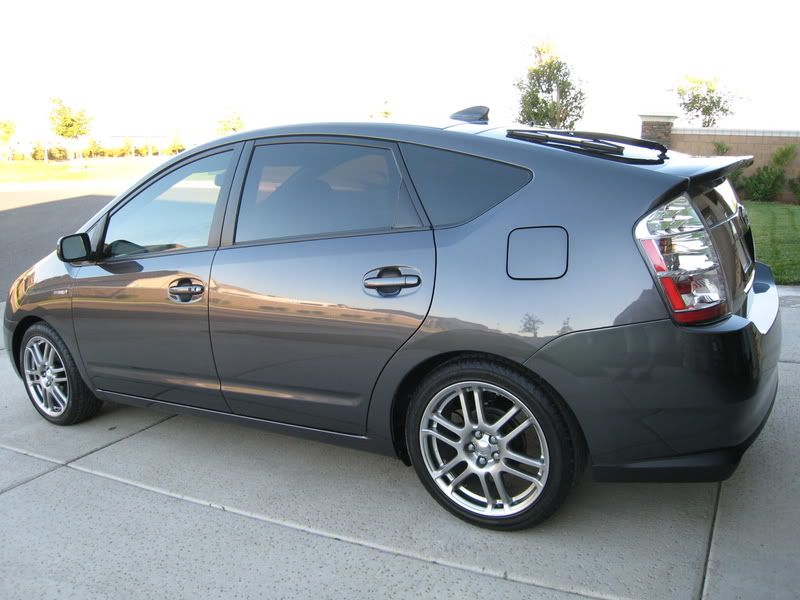
Oh, what kind of car is it? It's a 2008 Magnetic Grey Prius (this is a photo of a 2007... couldn't find a 2008 online). It has a start button, I kid you not, and so long as the key is in my pocket the door unlocks automatically and the car will start without having to put the key in the ignition. The thing is unlike anything I have ever seen before. It's not the kind of car I would say is a blast to drive... not that it's not fun, but it's no sports car. What it is is the kind of car I won't feel bad driving around town to do errands.
Now, the close reader may have been wondering, how was it I was able to move to the beach and yet still get to my old job downtown. That's a good question, and if you didn't think to ask it, you're not paying close enough attention. Either that, or you didn't know me well enough to learn my most closely guarded secret. As a child I never learned how to ride a bike. That's right, never complete with italics and everything. So, when work became a 40 minute walk it was not just a simple matter of hopping on the bike. But with the help of some very dedicated friends I managed to teach myself how at the ripe old age of 26. Now I'm a regular speed machine, zipping up and down the streets of Santa Cruz on my new Trek hybrid bike. It's a hybrid because it's half mountain bike (good for hills and stability) / half street bike (good for going fast).
So, that's the sum of things. I'm headed out now to attend my first Santa Cruz Obama organizers meeting to see if there's something I can do to help with the campaign. Looking forwards to meeting some new people, since the new job is home based.
Thanks to anyone who kept checking during my hiatus, I promise to be better for at least a little while.
Friday, August 03, 2007
Stupid Federal Appeals Court...
It's been months, months, since I last blogged, which is really a shame because there are so many interesting things I could have blogged about. Supreme Court rulings, 2008 Presidential Primary shenanigans, new web projects, plans to move, looking at new cars, etc, etc. And yet, for whatever reason, I didn't "pick up my pen" and it is my loss.
But today I read something that really makes my blood boil, so I'm back at the keyboard ready to take a stand. Feel free to read my primary source first, but if don't have the time, here's the summary. Pharmaceutical companies hold patents on drugs that give them sole authority over who gets to manufacture the drug. As a general rule, they elect to only allow themselves to make the drug, which means they have zero competition and without competition they can set whatever prices they want. Most non U.S. countries combat this by regulating the price of drugs, the result is in the United States drug costs are quite a bit higher than any where else in the world.
So, the District of Columbia, in their own effort to combat what they see as excessive prices, adopted a city ordinance that allows for a civil suit if the cost of a patented drug is 30% higher than in Canada, Germany, Australia or the United Kingdom. On appeal to the Federal Circuit Court of Appeals--my least favorite court for a number of reasons I've previously blogged about--deemed this to be in violation of the patent laws and an illegal usurpation of federal power.
I say fooey to that. But D.C. Council member David A. Catania has a more nuanced responce.
As is well documented, on the topic of patent law interpretation (as opposed to patent application) the Federal Circuit has a very poor record. If the Supreme Court accepts cert, and I pray they do, you can bet the farm they will overturn as they have nearly everytime the Federal Circuit has claimed its specialized area of law trumps all others.
When will Congress realize that giving an appeals court exclusive jurisdiction over a single area of law while denying them any jurisdiction over other areas ensures that the exclusive area will become paramount in all matters? Laws must be balanced with consideration to the competing interests and a specialized court like the Fed Circuit is tantamount to pressing down on one side of the scales.
But today I read something that really makes my blood boil, so I'm back at the keyboard ready to take a stand. Feel free to read my primary source first, but if don't have the time, here's the summary. Pharmaceutical companies hold patents on drugs that give them sole authority over who gets to manufacture the drug. As a general rule, they elect to only allow themselves to make the drug, which means they have zero competition and without competition they can set whatever prices they want. Most non U.S. countries combat this by regulating the price of drugs, the result is in the United States drug costs are quite a bit higher than any where else in the world.
So, the District of Columbia, in their own effort to combat what they see as excessive prices, adopted a city ordinance that allows for a civil suit if the cost of a patented drug is 30% higher than in Canada, Germany, Australia or the United Kingdom. On appeal to the Federal Circuit Court of Appeals--my least favorite court for a number of reasons I've previously blogged about--deemed this to be in violation of the patent laws and an illegal usurpation of federal power.
I say fooey to that. But D.C. Council member David A. Catania has a more nuanced responce.
It implies that patents would ban any legislation that affects the ability of patent holders to charge whatever they please, which is absurd. The Supreme Court has already upheld legislation that mandates price discounts to participate in Medicaid formularies. And no one has argued that states cannot enforce antitrust and other rules that limit monopoly prices of drugs indirectly -- although the full logical thrust of the opinion would do just that.I tend to agree. Patents only authorize the patent holder to control manufacture and use, it does not convey absolute pricing control, although absent regulation it is the natural result of a patent. But if this court ruling is correct, it means that if I obtain a patent on gun, which a state later decides to ban, or at least regulate, for safety reasons, the state would be in violation of the Patent Act and unable to do so. Essentially, anything patented is beyond state regulation! (The Congress, I presume, can still regulate under the ruling since they have the authority to trump the Patent Act.)
As is well documented, on the topic of patent law interpretation (as opposed to patent application) the Federal Circuit has a very poor record. If the Supreme Court accepts cert, and I pray they do, you can bet the farm they will overturn as they have nearly everytime the Federal Circuit has claimed its specialized area of law trumps all others.
When will Congress realize that giving an appeals court exclusive jurisdiction over a single area of law while denying them any jurisdiction over other areas ensures that the exclusive area will become paramount in all matters? Laws must be balanced with consideration to the competing interests and a specialized court like the Fed Circuit is tantamount to pressing down on one side of the scales.
Subscribe to:
Posts (Atom)